

Indexing African Artifacts
Developing an archival index to unlock latent meaning through comparative symbolic analysis

Introduction: Taking Ownership of the Archives
In the theme of taking ownership of the archives, we’re tackling the challenge of creating an index of African artifacts in museums across the world. It’s a well known fact that a vast amount of Africa’s material heritage is held abroad, and attempts at reparation are highly controversial. This project comes off a longtime fascination with this reality, clarity of demand and interest at various levels, and deepening awareness of the power of understanding Africa’s history as manifested through artifacts.
As mentioned before, this project is informed through manual indexing, archival and sharing of artifacts by us and many other enthusiasts as are common on social media. The approach is integrated with a growing knowledge of African history through researchers and archaeologists, notably Prof. Akin Ogundiran, and draws from Isaac Samuel’s recent overview of the museums that hold many of these artifacts.

Engaging with principles of open data, espoused by Museums’ digital data departments, creative commons licenses permit syndicating content about artifacts for educational purposes. Computational means including open APIs and public catalogs allow for this indexing effort to be fulfilled with minimal resources.
A big driver of urgency of this project is the opening of the MOWAA and the controversy around the returned artifacts, highlighting the unfortunate persistent issues with accessibility and cultural understandings of the artifacts’ value. It’s clear that:
Physical reparation is not an end in itself: redeeming the artifacts also requires understanding them collectively, such that the intangibles and knowledge they encode are also restored, allowing them to be valued appropriately and not merely as tokens or sentimental relics
Gleaning and sharing more about these artifacts and what they represent is of key importance, in steeping them in the collective context they’ve been robbed of and redeeming their full physical and metaphysical value. Further comparative analysis and research shows promise in revealing deep insights about history, culture and consciousness
Much can and should be done with the available digital archives across the world, pending physical reparation and given the difficulties facing and relative dearth of continued archeology in Africa — the digital space offers a unique ability to catalog and comparatively analyze artifacts in order to unlock deeper insight about them
Why a Centralized Index of African Artifacts?
Well beyond a “symbolic” gesture, or a mere data mining effort, there’s immense power in building an understanding of African artifacts, their purposes and the knowledge systems and mythologies encoded therein. There exists much information about artifacts, scattered across museums and syndicated with varying levels of fidelity on social media.
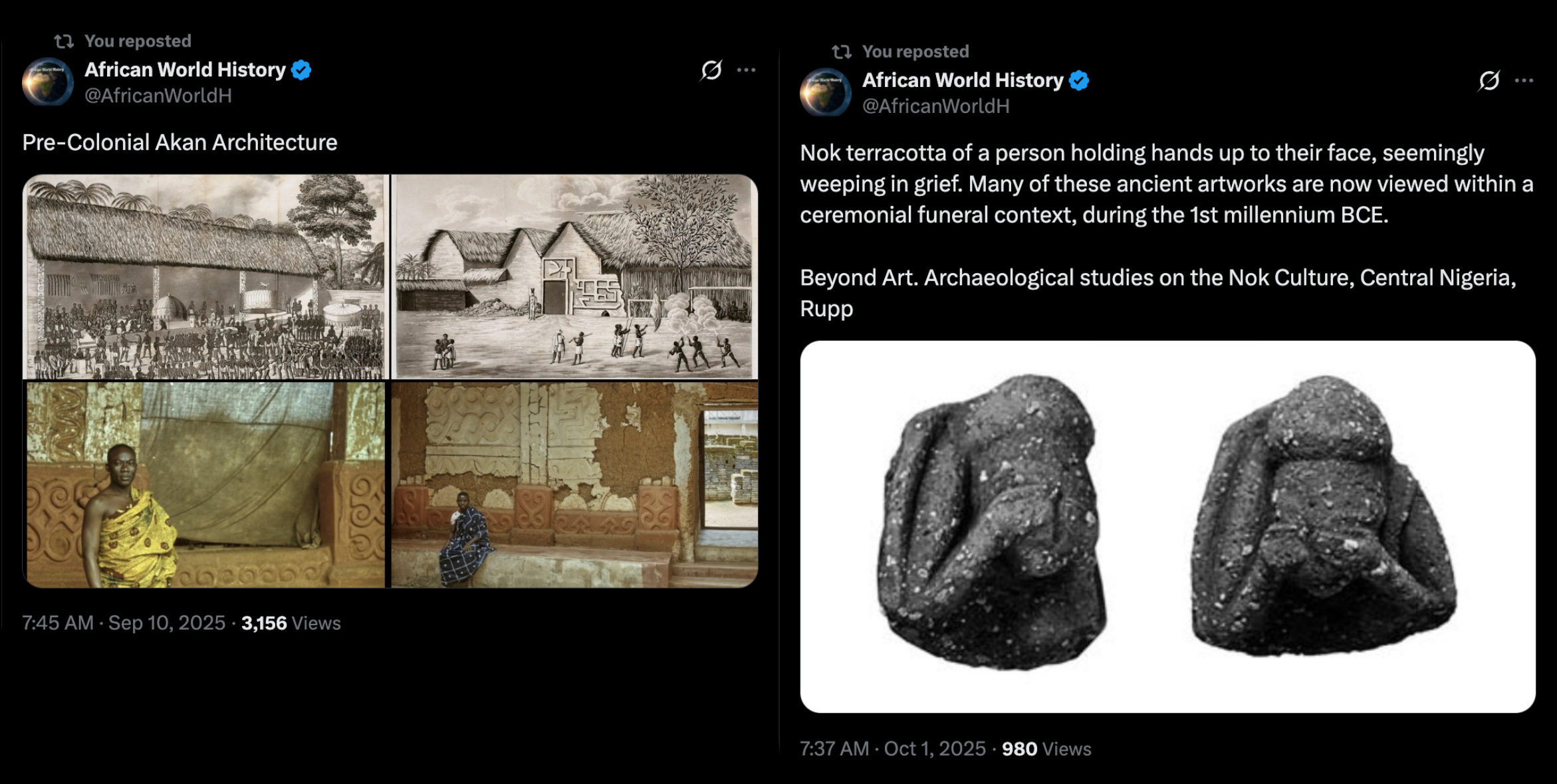
There’s also a generally limited understanding of the full breadth and depth of Africa’s material heritage, in terms of chronology (age of artifacts), geography (places and historical sites represented) as well as comparative relationships — this last fact is pertinent in light of Africa’s often fragmented cultural landscape, with a lack of mutual understanding among cultures that’ve arguably coexisted long in the past.
In digitally archiving, cataloging and analyzing these artifacts, even in advance of physical repatriation, deeper comparative insights can be unlocked. Take the examples of:
How certain artifacts like Igbo Ikenga totems, Edo ivory carvings or (notably, as we’ve already analyzed) Yoruba door panels serve to chronicle personal and collective histories, corroborating oral narratives and expanding the corpus.
The overlap in stylistic and constituent properties of Nok, Sokoto and Ife terracotta, or Igbo Ukwu and Ife bronzes, as well as common textile motifs between the Ijebu and Ijaw kingdoms, which points to industry as well as potential knowledge and skill transfer in antiquity
These theories have been explored speculatively to some insight. Hence, looking at the artifacts in light of these theories, at a greater scale, promises much more insight in these regards — and without a doubt serve as sources of novel theories on cultural relations.
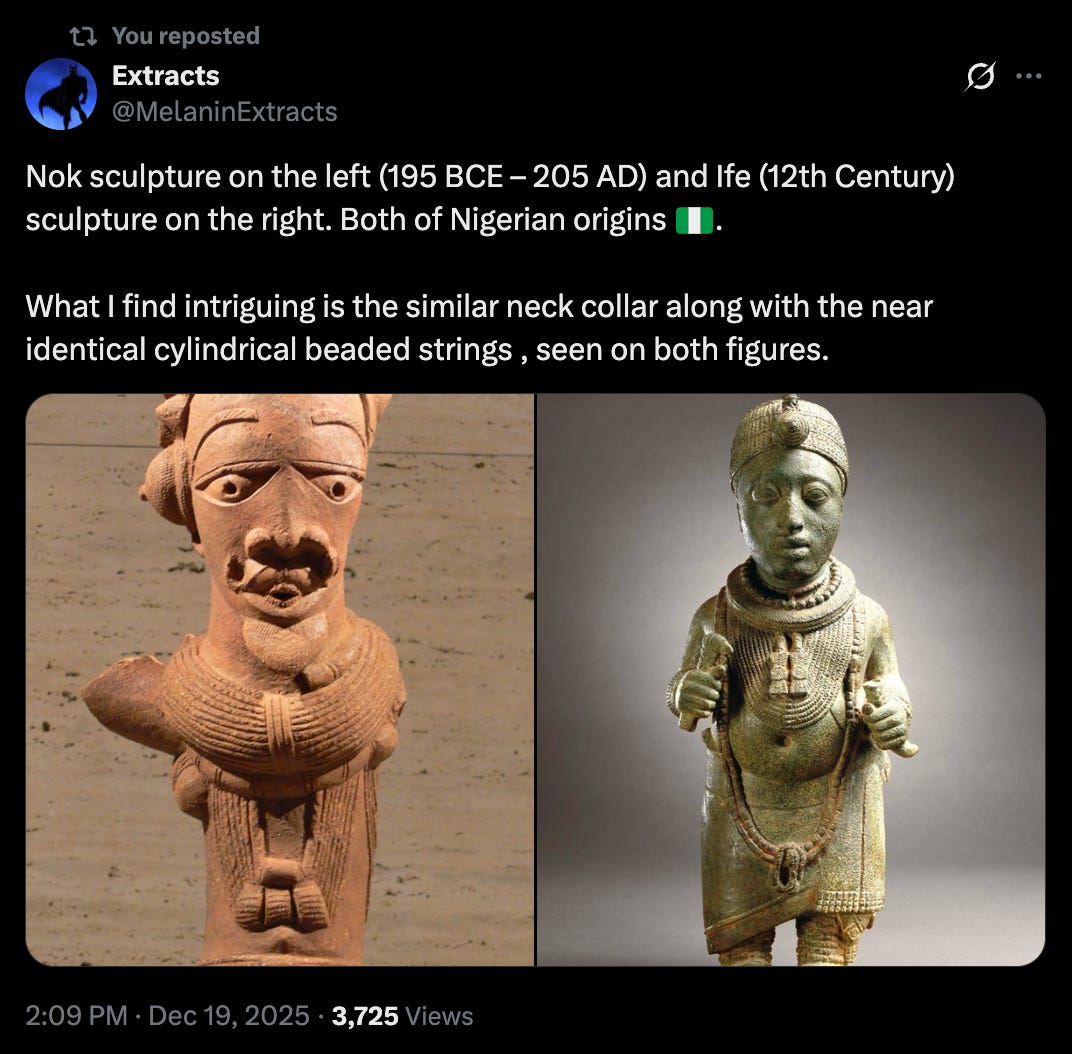
While the centralization of the index is helpful for consolidation, it is not intended to be “closed source” or to simply extract value from the artifacts, but rather to serve new value as can be provided by an index/catalog and comparative analysis tool. Additionally, the fact that this index syndicates data from other museums necessitates source referencing, a focus on education, and precludes monetization.
The Progress so far: Archiving, Indexing and Comparatively Analyzing
Ahead of embarking on a large scale indexing effort, we’ve theorized and done some manual analysis that has revealed concrete empirical and promising speculative pointers to the power of comparative analysis for these artifacts, identifying symbolic systems and motifs with high potential for insight:
In our recent deep-dive and speculative analysis, Yoruba door panels contain distinct narrative forms. These often reflect common symbolic motifs as well as corroborate oral histories and philosophies like those encoded in the Odu Ifa. See our detailed analysis of a specific set of archaic panels from the German Archeological Institutes 1912 expeditions here
Weave patterns are a common motif in Yoruba art work, and our analysis shows evidence of these symbolizing numerics in different contexts. These also seem to appear in those of other cultures — notably Lusona drawings, where they serve as abstract representations of narratives or proverbs, and are even considered similar with such systems on the Indian subcontinent.
The Nsibidi symbolic system of the Igbo and other peoples of south-eastern Nigeria, having established translations for narration, representing both tangible and intangible relationships and objects. The preservation of this system seems to have gone from being a part of ancient education, to a system maintained by secret societies, and now one that appears not (yet) to be obscure in the fullness of its meaning, through which it might serve a more generative purpose in society at large.
Chevron “V” patterns in Kongo art are documented to have concrete ontological meaning, as understood as in ancestral knowledge (secret) societies and popularized through academic philosopher and initiate Prof. Fu’Kiau

Read more on these threads of inquiry on Symbolism in African art here:

With these existing paths from established research, and our empirically-backed speculations on individual artifacts or motifs, we’ve gone ahead to lay the groundwork for comparative analysis at a larger scale. This has now taken concrete shape as:
African Artifacts Index
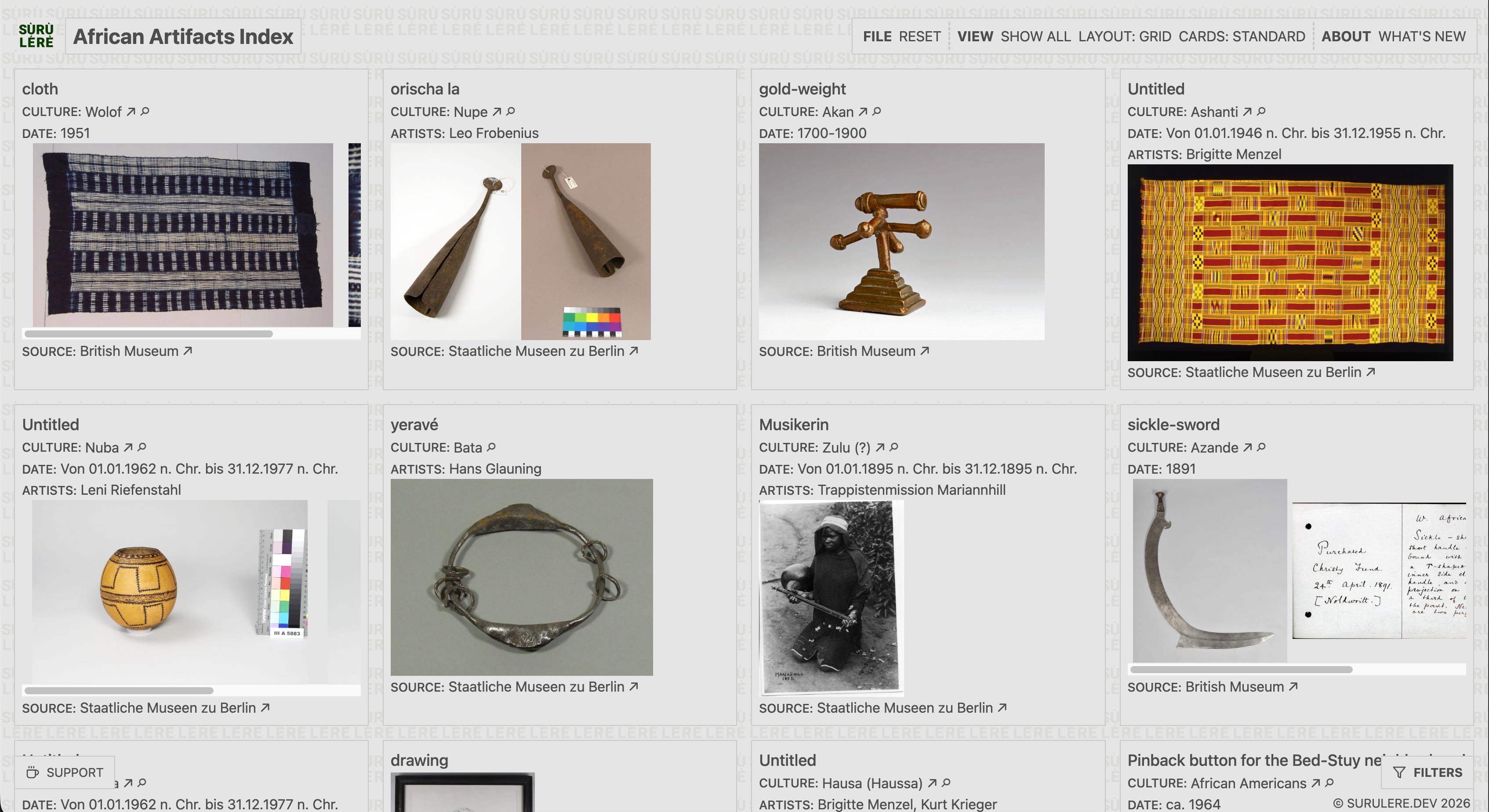
Technically speaking, this uses computational means to index relevant digital archives of several museums into a consolidated interface. This is a central source for artifacts from across the continent, as illustrated by the map view for narrowing down your exploration.
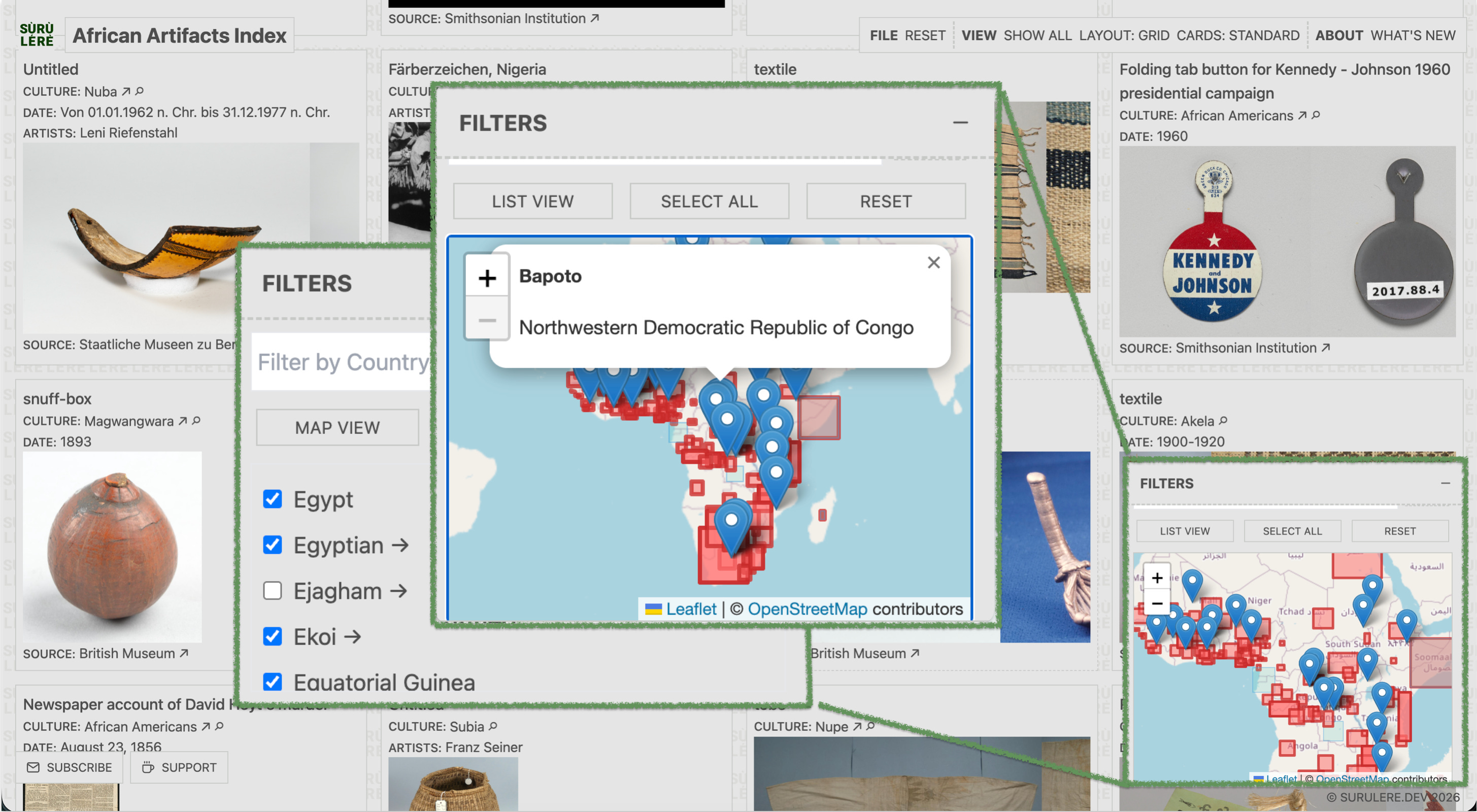
Additionally, we’re analyzing artifacts for similarities, both in the textual/semantic context about them (materials, related cultures, provenance and descriptions), as well as the visual context as to their form and things like the appearance of certain motifs (this visual aspect is more complicated, yet is a ripe ground/challenge for both adapted and novel means of analyzing images). The next section shows great examples of these comparative analysis tools and insights so far.
What Larger Purpose Sustains this Work: Paths Forward and Fuel for the Fire
Evidently, there’s an interest in and need for more knowledge of Africa’s heritage. Looking at two threads here that are relevant path forwards from this project:
There’s a whole lot of interest in African intellectual and creative history from different angles including ancient oral traditions, written accounts from Arabic/Ajami scripts as well as new world chroniclers, and archeology of well-known and obscure sites. Artifacts offer another great frame of reference for histories, with a clear aspect of dating and origin/provenance.
There’s much to be understood and reconciled about the cultural and relational history of Africa, and artifacts serve as concrete witnesses. In looking at history intersubjectively and holistically, seeking connections that bridge cultures in a non-oppositional way, critical analysis of artifacts is a promising path forward.
On both these fronts, there is a bias to examining these histories with a dialogical lens, assuming cultures are more interrelated than not, as opposed to looking only at what makes individual cultures distinct. This is an intentional bias that’s aimed at establishing more unity between cultures through shared or related identity, as evidenced through archetypal motifs in physical and other historical artifacts – this is also the reason I choose to explore various African cultures, rather than focus on the Yoruba or Nigerian cultures alone. Indeed, the comparative analysis tools already show interesting bridges, acknowledging the interrelationships between cultures across Africa’s externally-defined borders:
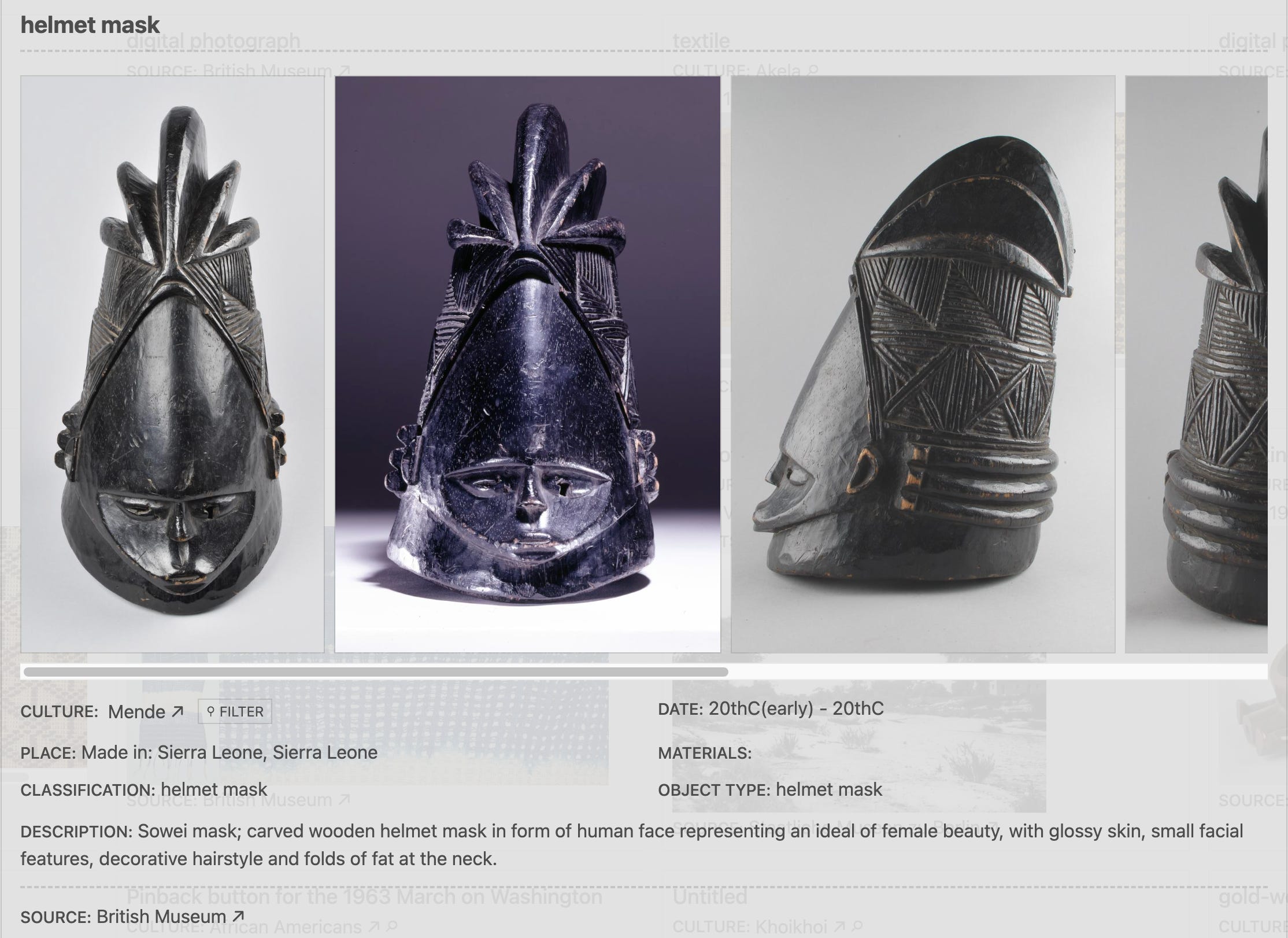
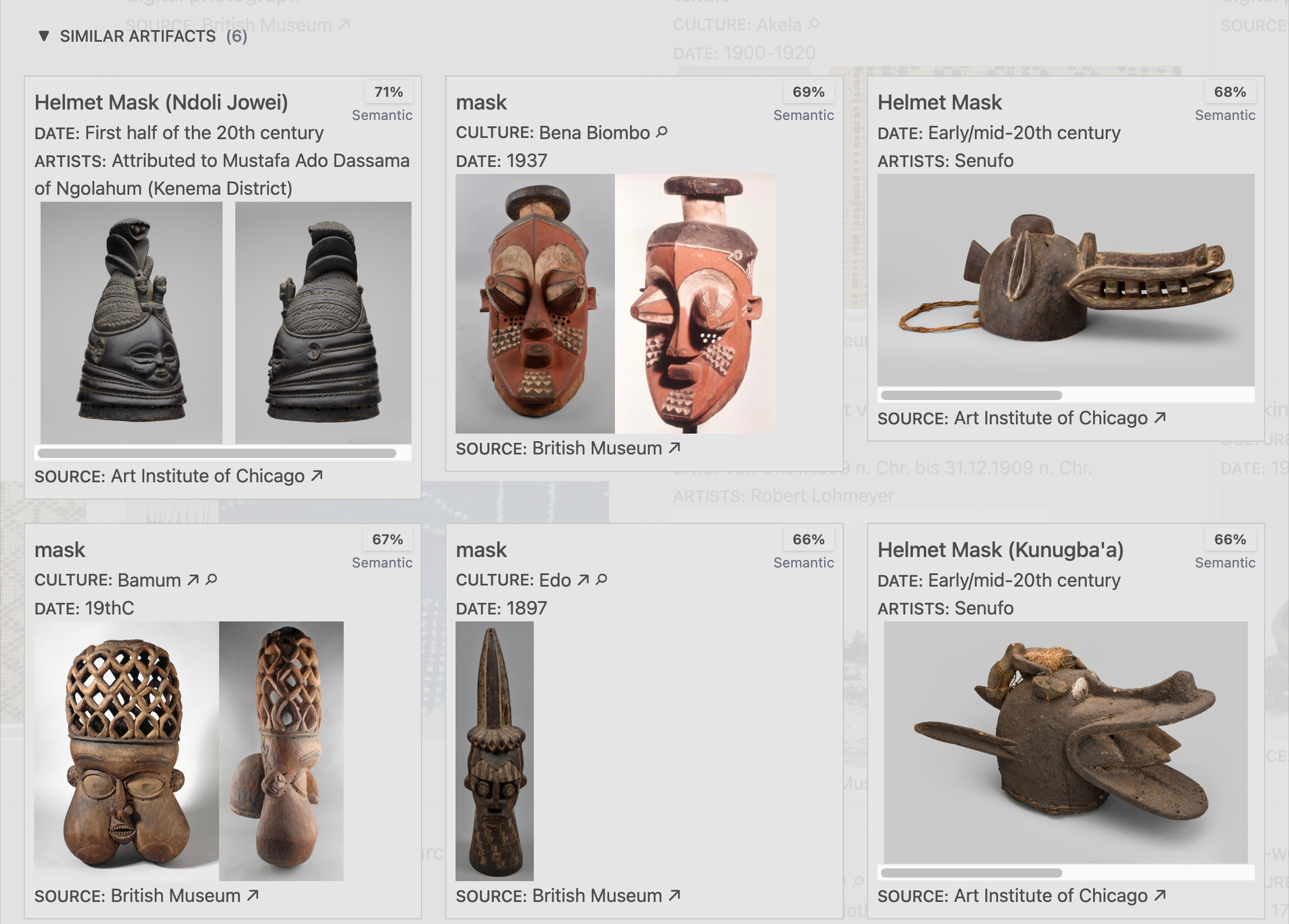
Ceremonial helmet masks, seen across Mende (Sierra Leone), Senufo (Ivory Coast, Mali and Burkina Faso), Bamum (Cameroon) and Biombo (Congo) [Artifacts Index link]
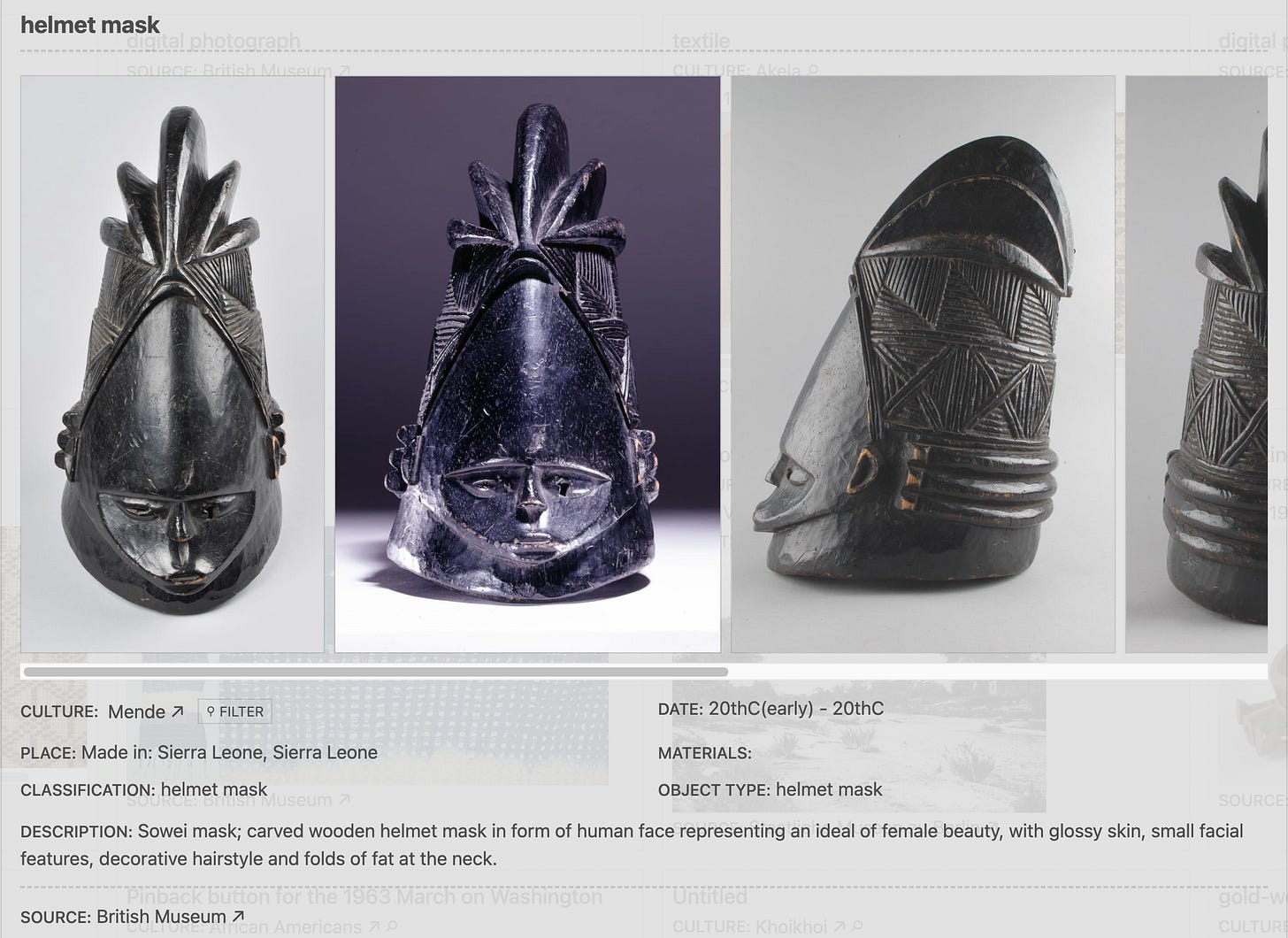
Detailed information on this Helmet mask artifact, covering culture and source country, a general description, and (a link to) the museum where it’s housed 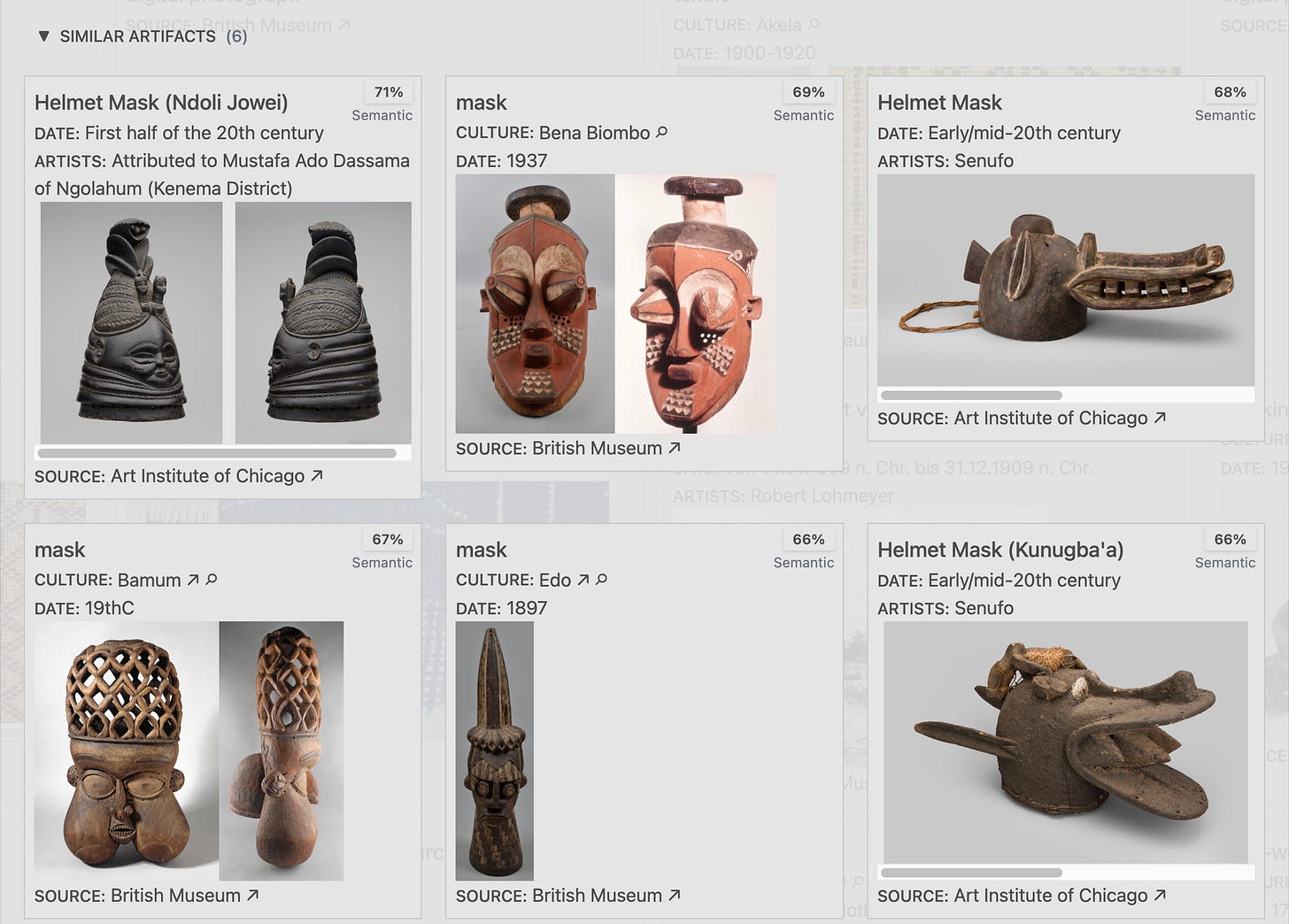
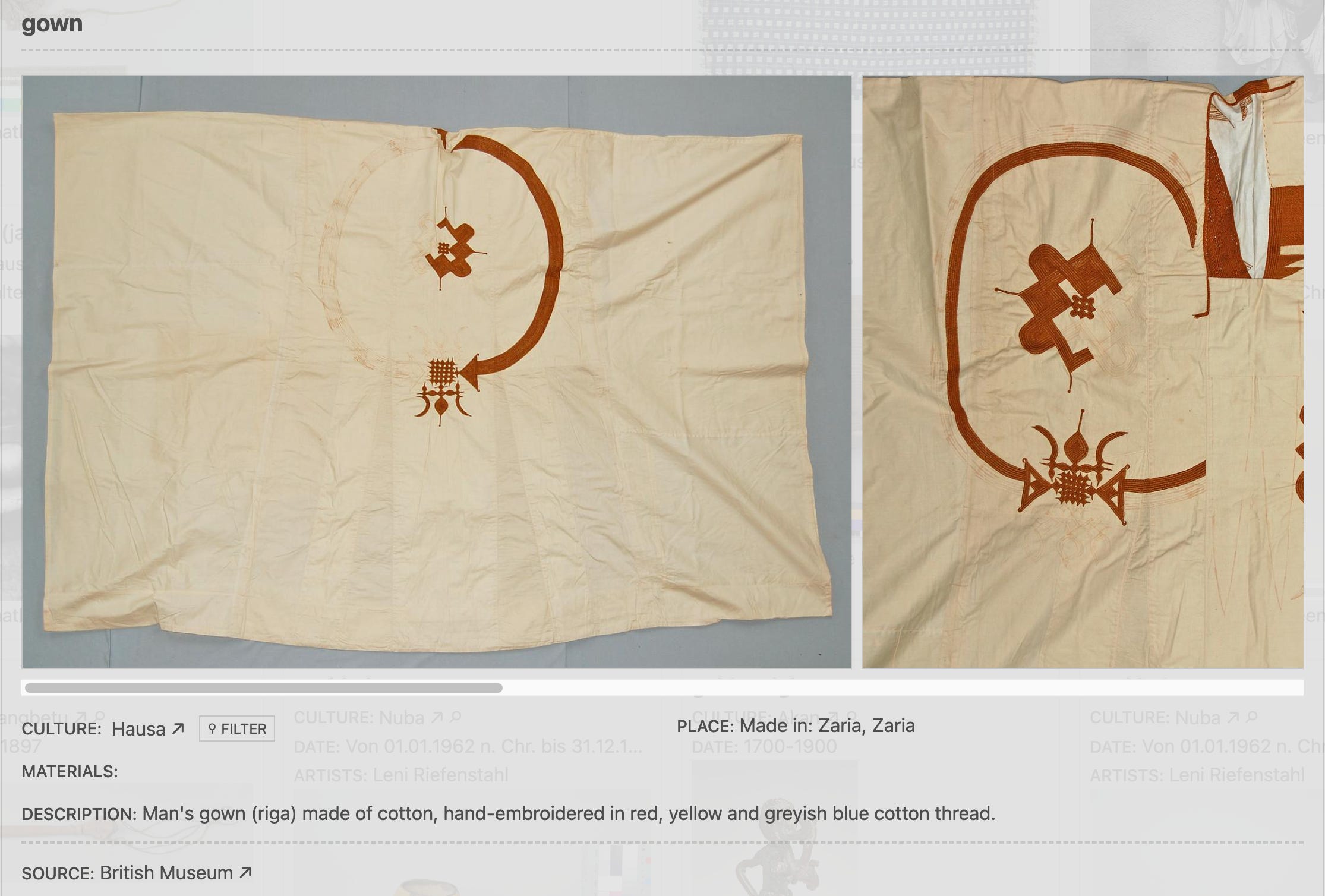
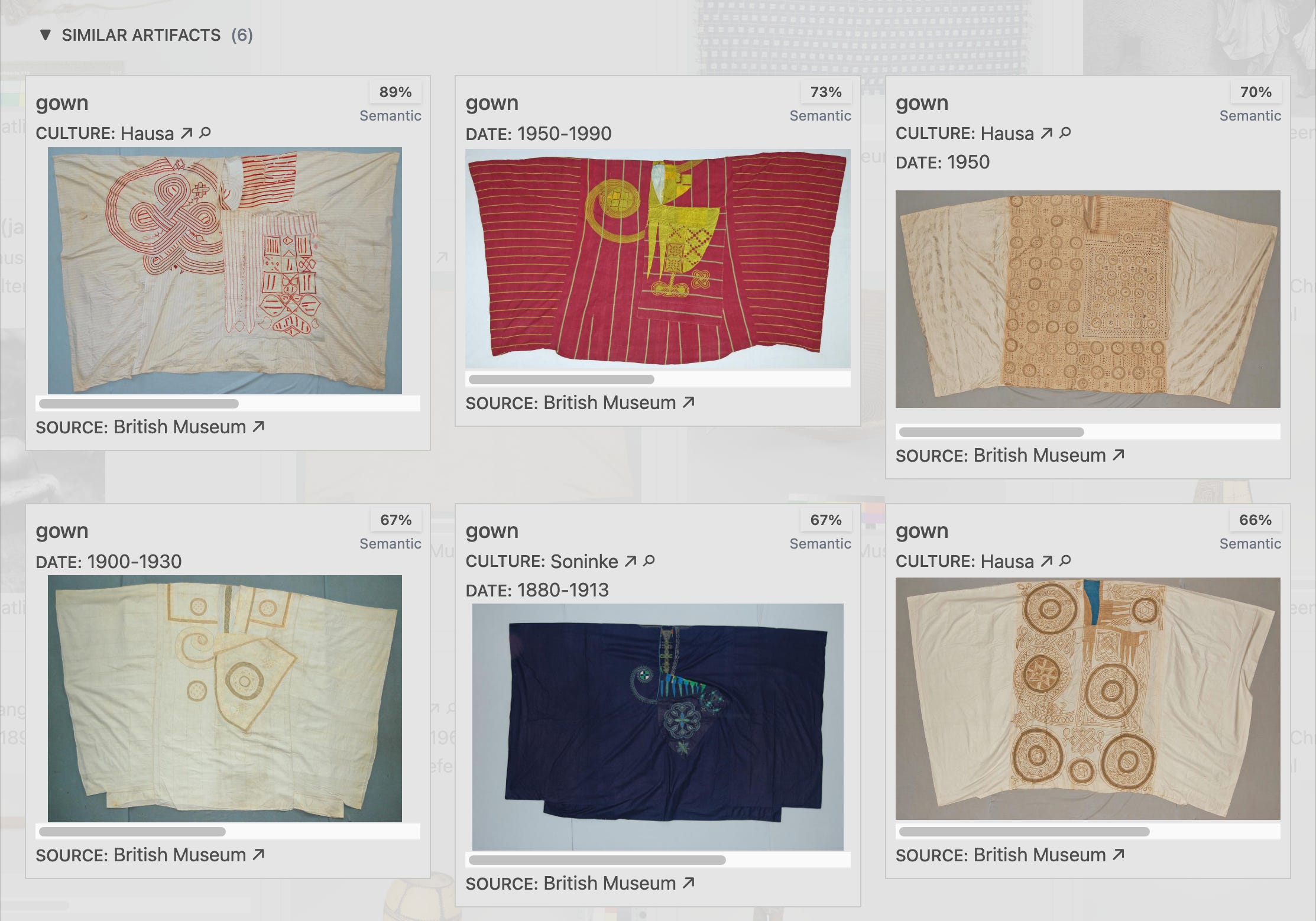
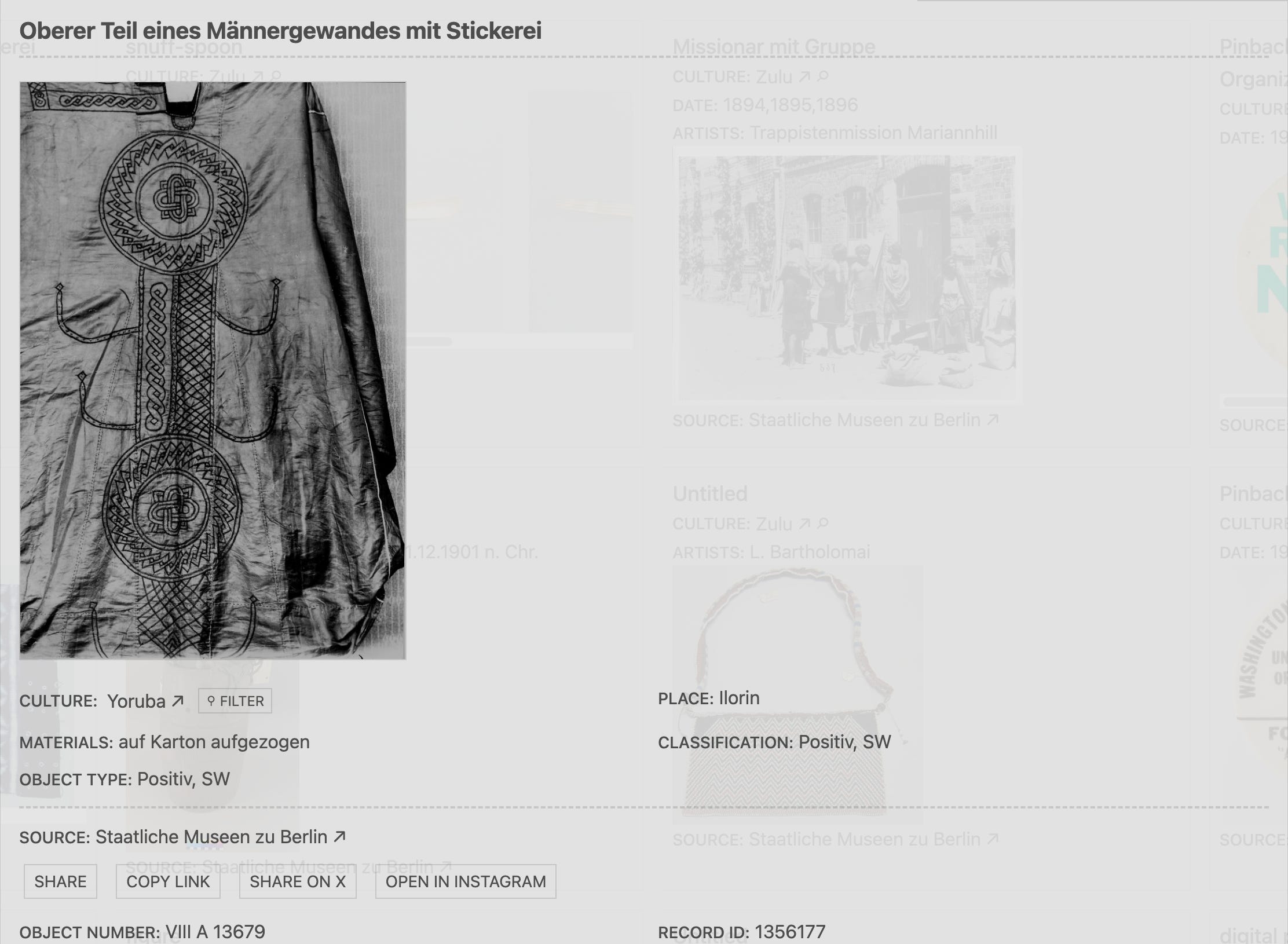
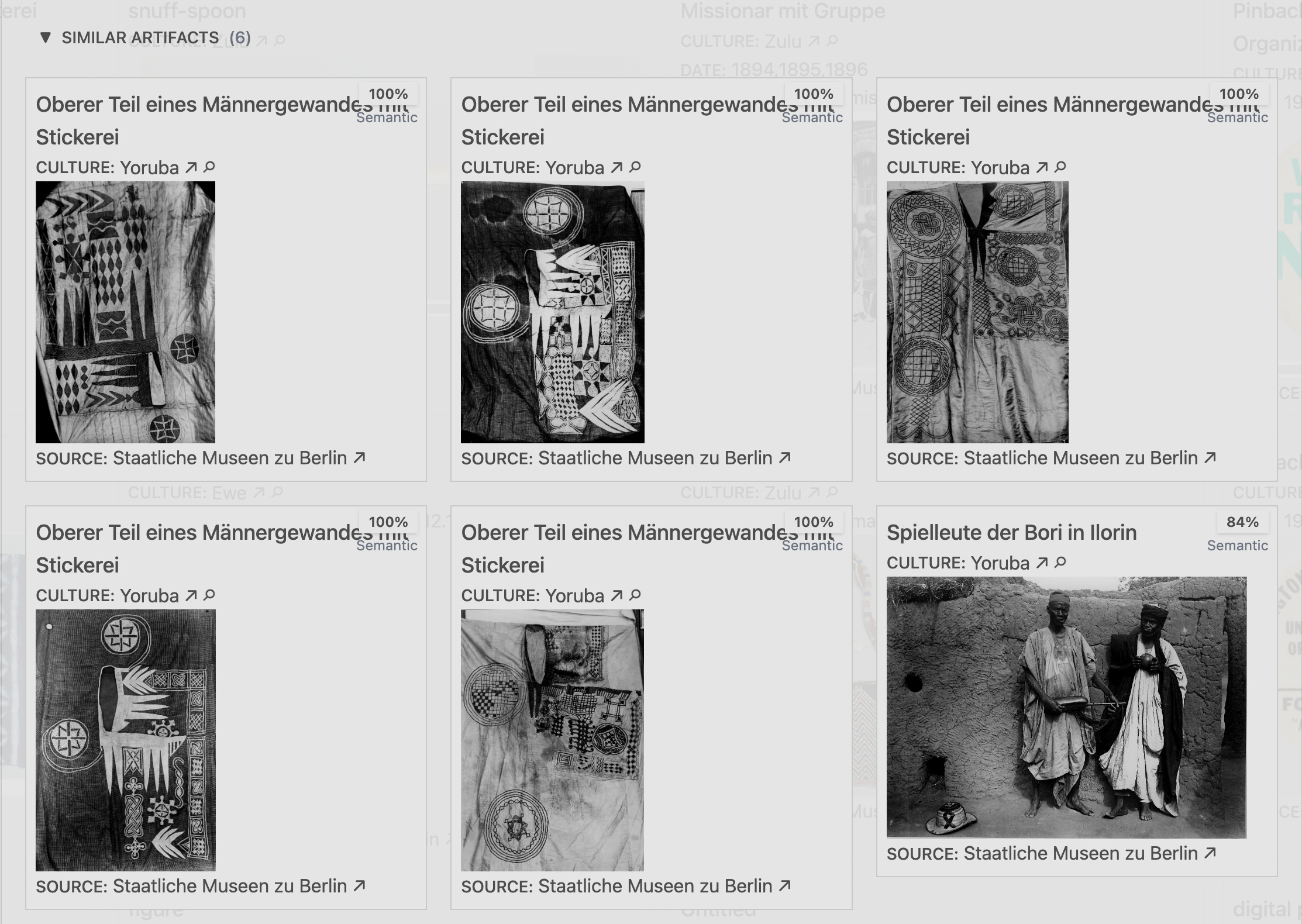
Scrolling down in that same page, and clicking the “SIMILAR ARTIFACTS” dropdown queries our database for semantically similar artifacts Embroidered gowns, seen across Hausa and Soninke (Mali, Mauritania, Senegal, Gambia, Guinea) cultures [Artifacts Index link] as well as among the Yoruba in northern regions like Ilorin [Artifacts Index link]
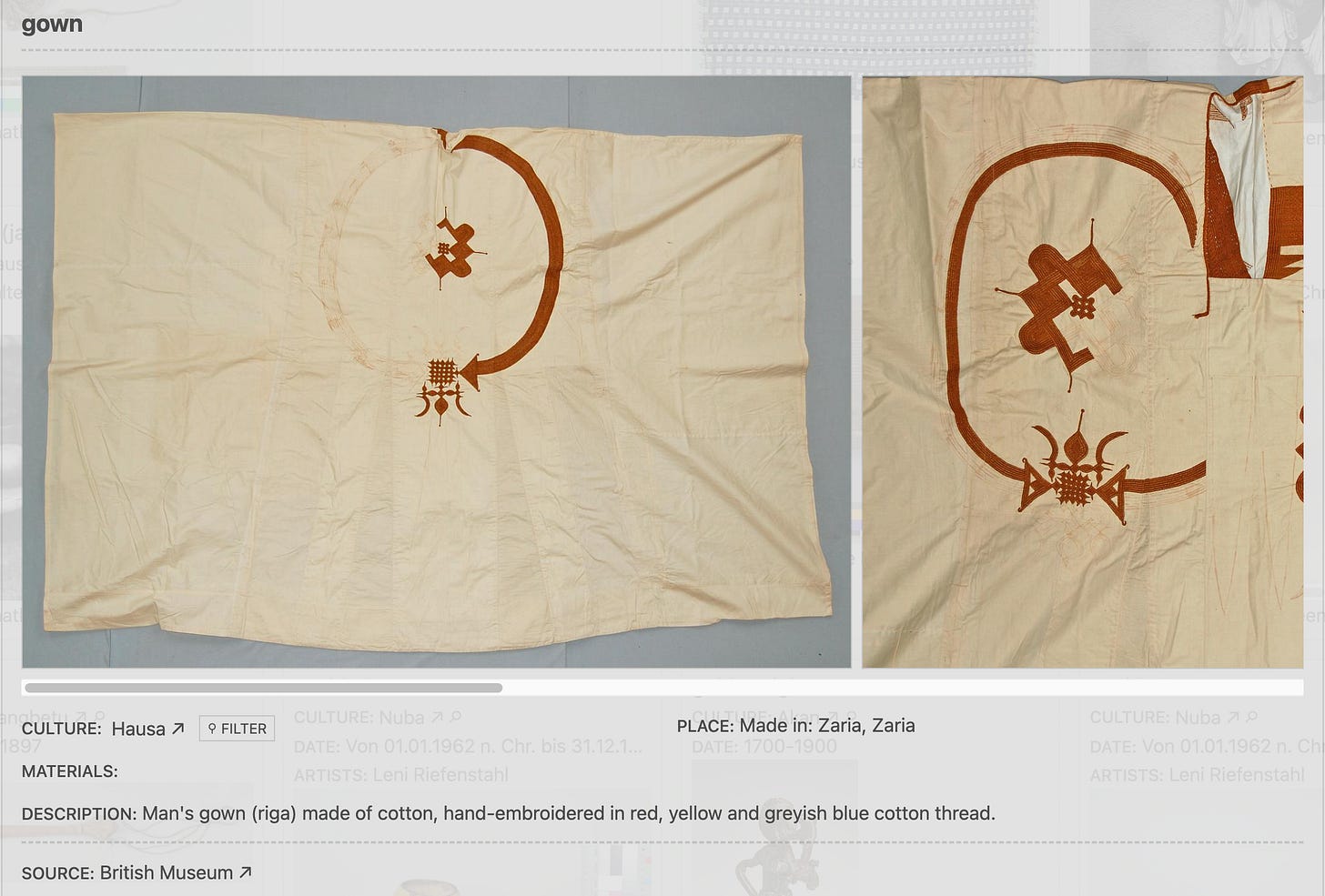
Detail page for the former “embroidered gown” artifact linked above 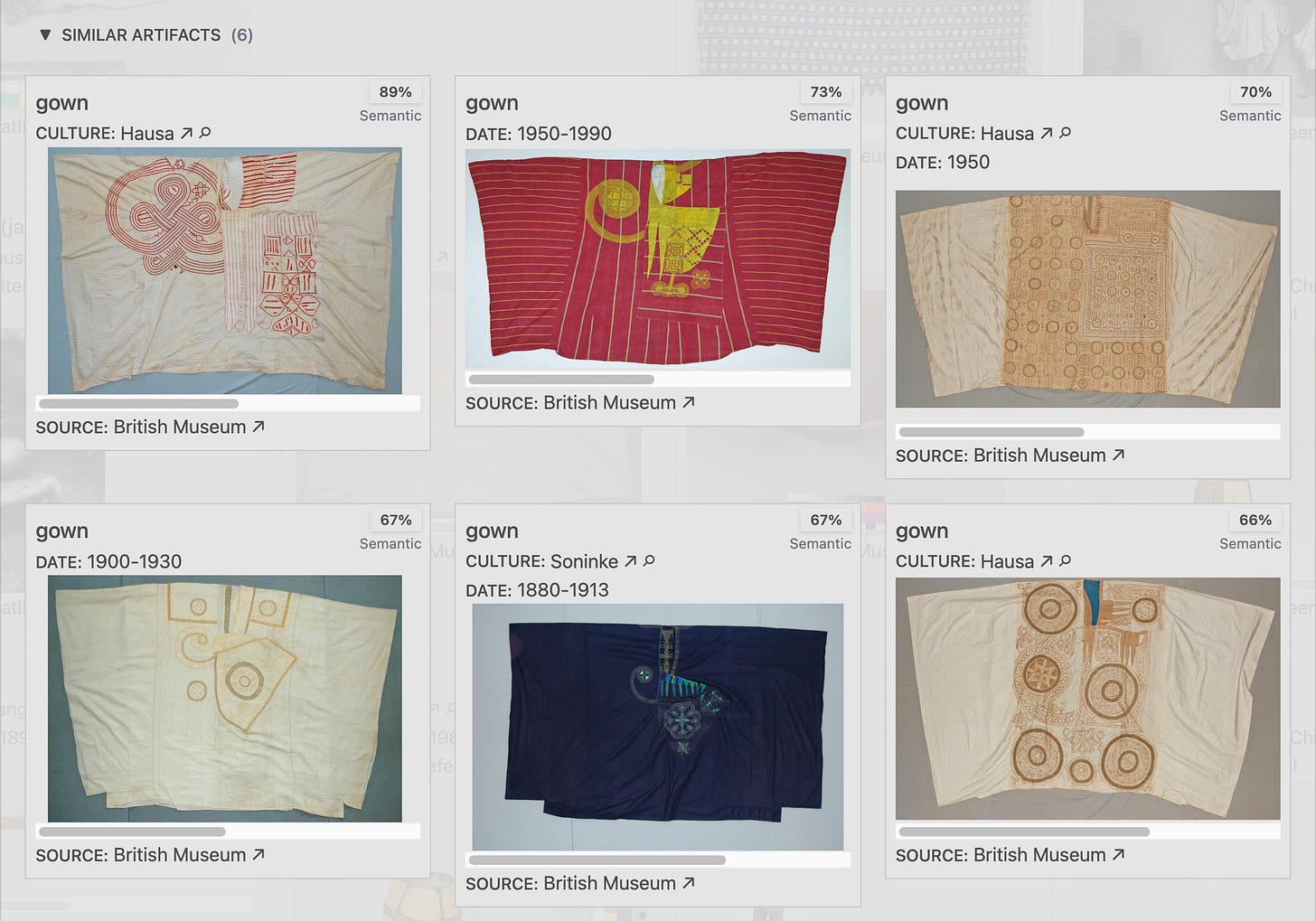
Similar artifacts dropdown on the detail page for that former “embroidered gown” artifact 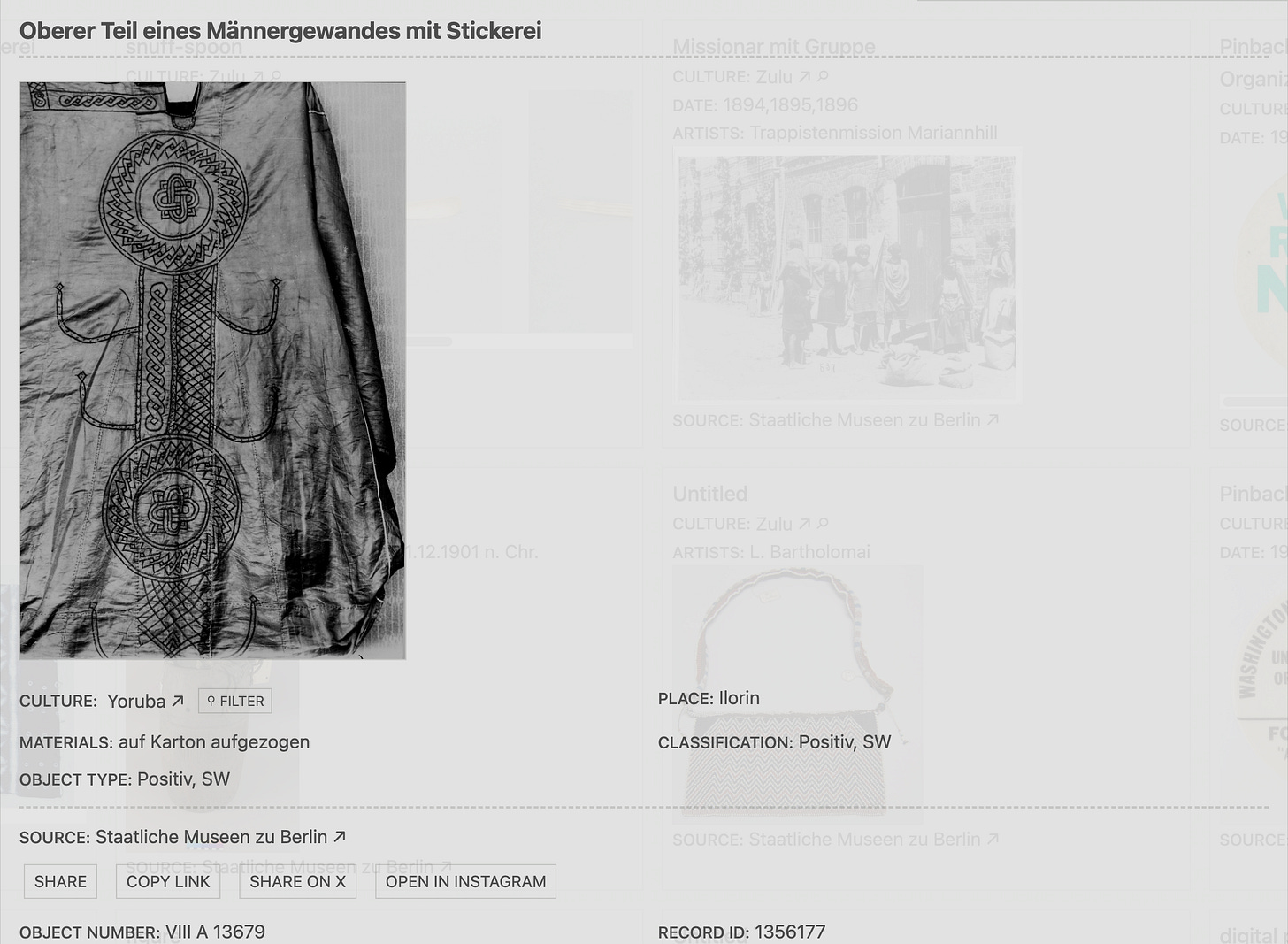
Detail page for the latter of the “embroidered gown” artifacts linked above, this one from Yoruba country. Retrieved from SMB museum in Germany 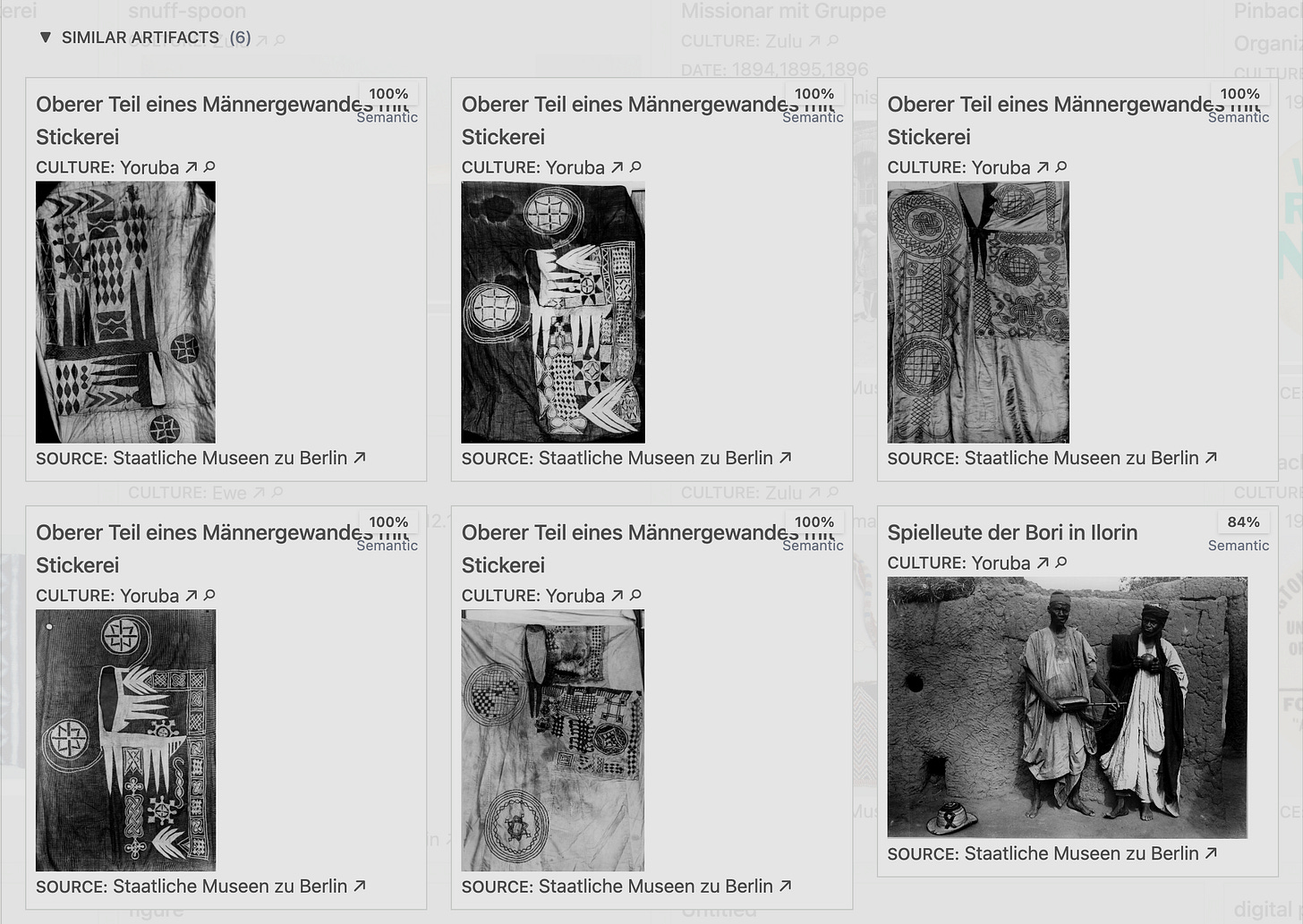
Similar artifacts dropdown on the detail page of that latter “embroidered gown” artifact Standing ancestor figures, seen across Fang (Gabon), Tiv (Nigeria), Babembe (Congo), Mbole (Congo) cultures [Artifacts Index link]

Detail page for the “standing man figure” artifact 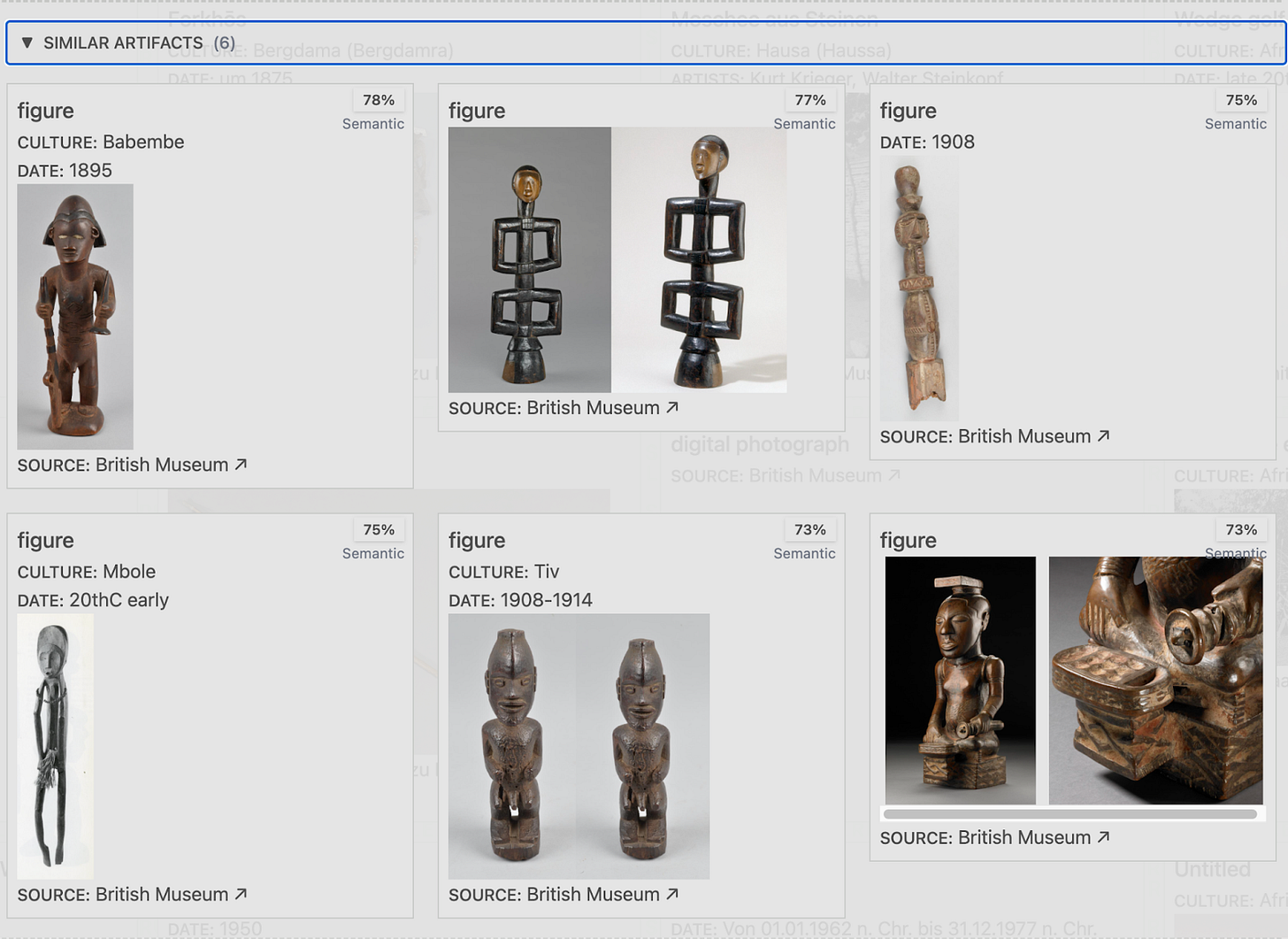

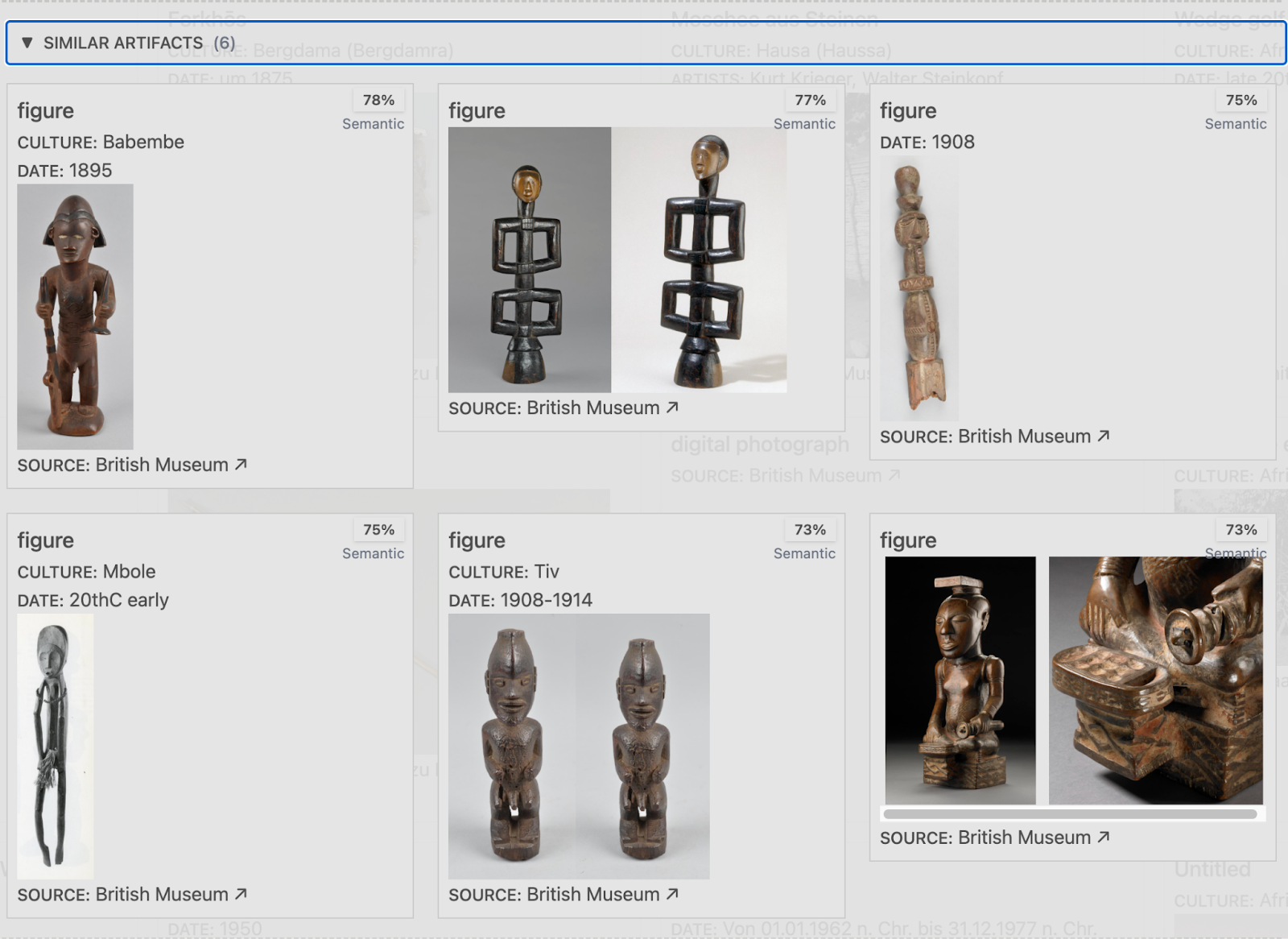
These are but a few examples of common motifs among thousands of other artifacts that are currently indexed in this archive.
Note that (at the time of writing) these links are established by looking at only semantic similarities in the descriptions and metadata of these artifacts. The next phase of this “Similar Artifacts” comparative analysis feature, will be to leverage visual similarity of the images and constituent symbolic forms of the artifacts. This unlocks a whole other layer of significant interrelationships.
The next branching off point for this project is disseminating the archived and insights from comparative analysis of artifacts in this centralized index. The structure for this will be a Wikipedia-supported grant to support the effort and provide accountability towards the goal — this post serves to kick off that off-shoot project, pending the Wikipedia grant. Concretely, this project will involve syndicating relevant artifacts and other visual archives into Wikipedia pages for various African cultures – further enriching a popular and trusted source for African history, and increasing accessibility to the general public.
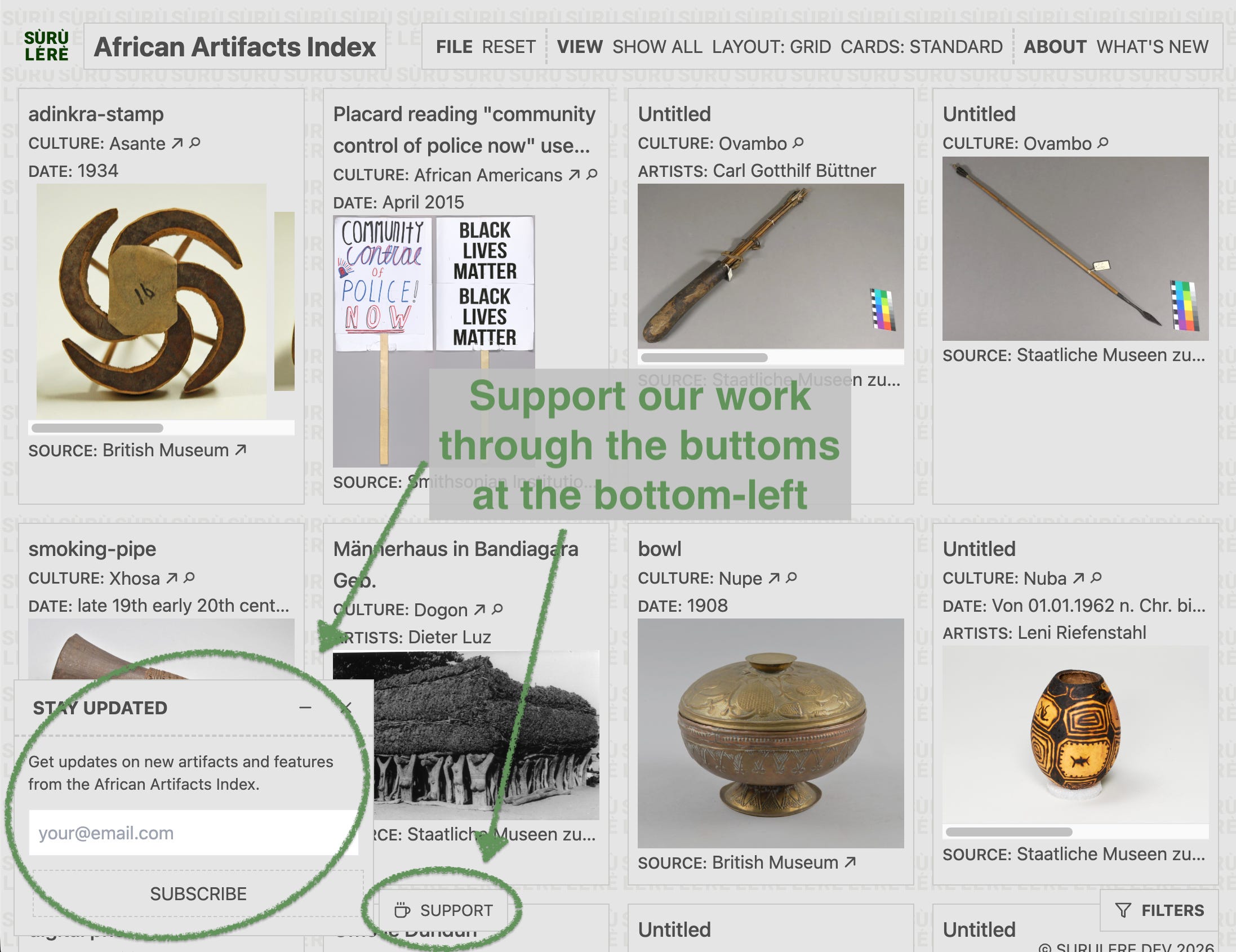
Finally, this project has built in features to align accountability, engagement and support for this work publicly. This includes a mailing list signup, for new updates or regular digests of interesting artifacts, share links for further syndicating these links to social networks, a change log listing the projects development milestones, and a means to support the project via donations.
Conclusion: Why is this Work of Personal Importance?
This article would not be complete without a personal reflection on what brought us around to doing this work, and our hope to be a good vessel for bringing this to fruition. To quickly summarize:
This project consolidates a lot of our interests in history, archeology, archetypal psychology, as well as data processing and machine learning. It’s engaging these interests, and culminating a lot of learning and career and passion-driven exploration over the past several years – in specializing in web and infrastructure software development, and a sensitivity for user needs at various scales; as well as in sustaining an archival practice, and building close familiarity with historiography, sociology and philosophy with a focus on Africa
The wider community of historians, researchers, artists and enthusiasts are ultimately key stakeholders in such a work. It’s a blessing to be connected with folks like this, including childhood elders like Rev. Dr Kehinde Olabimtan and Mrs. Molara Wood, as we also seek out more like-minded community members and elders. From this starting point, we feel equipped and supported in achieving the goals stated above.
Finally, there’s a deep humility in approaching such a project, and engaging with cultural materials that hold a certain numinosity – these are sacred artifacts for cultures around Africa, displaced from their context and value. I hope for grace and support from God, the ancestors and the contemporary community in stewarding this project, and anything that proceeds from it.
This is a huge project. I’ve worked at similar commercial projects and a key lesson learned is to *never overreach*. In other words don’t build something that can’t be supported, and don’t depend on any single person. In other words - the only way to get things done in academia won’t work in this level of complexity. Cambridge alone has 1/3 million artifacts.
The way I would play it would be in incremental levels of resolution.
First, identify the players with artifacts (museum name, and a list of topics such as Mutapa, and contact people).
Then see if you can identify any catalogues they have.
Then you need a group to govern and steward and propose a structure of important ways to look at the data (called tags in software engineering.) The work will likely need local researchers and experts, and a central catalog, standardized tagging, and will become a perpetual project.
The only way these things work is as a federated group. Most projects of this complexity fail - it’s hard to create the initiative and keep it and motivate others, bad info can poison the project and render it useless, and time is an enemy to long term goals.
If this seems daunting, that is because it is. Years and decades - of it’s all throw away!
You should know that there are open source and commercial software products that help manage this process, usually called “data catalogs”. You need this even if you think excel is all you will need. For example, they can take text files and automatically generate the tags.
Wow amazing project 😍